
A Street Narrowed, A Community Ignored
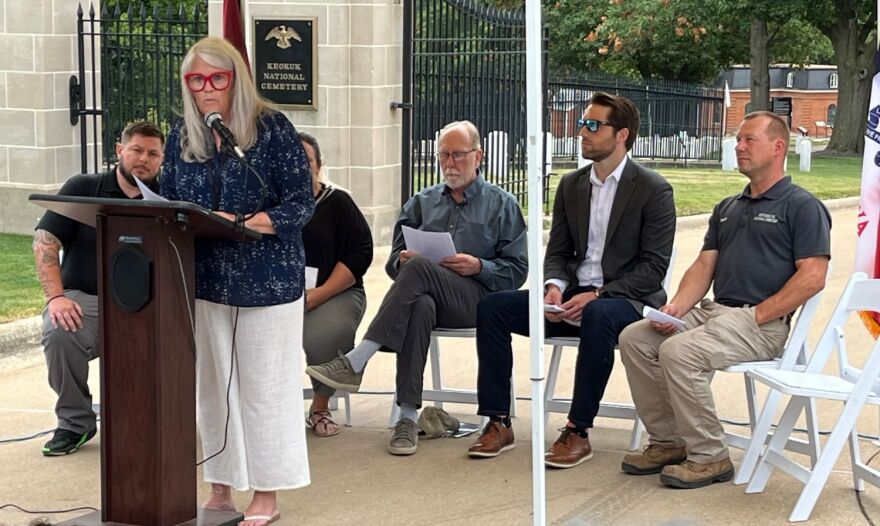
In 2024, Keokuk officials launched what was supposed to be a meaningful infrastructure upgrade: the complete reconstruction of South 18th Street, leading to Iowa’s only national cemetery. Marketed as a revitalization project and ceremonially renamed the “Road of Honor,” the undertaking was promoted as a tribute to local veterans and an overdue investment in the city’s crumbling roads.
The city secured nearly $1 million in federal Community Project Funding and issued local bonds as part of a $5 million capital improvement package. The seven-block reconstruction project was originally estimated at around $4.2 million. Work included new pavement, sidewalks, and utility upgrades. But soon after construction began, residents and business owners noticed a major and unexpected change: the new street was being built considerably narrower than before.
There was no public notice, no community input, and no explanation from the city until the project was already underway. For the residents and businesses along South 18th Street, the change wasn’t just cosmetic. Eliminating parking on one side created real challenges for accessibility, traffic flow, and emergency response. Local stakeholders were blindsided. A chiropractor who owns a clinic at 18th and Johnson raised concerns at a June 2025 city council meeting about lost parking for her patients, alley access issues, and even water service problems during construction.
In response to public backlash, city officials attempted to justify the narrower design by claiming construction bids came in higher than expected and they were forced to reduce the width to stay within budget. But residents pushed back hard. If the project was properly funded at the outset—as advertised with federal support and bond revenue—where did the money go? Why was the change hidden until construction began?
Public anger mounted. An ordinance to ban parking on one side of the street, introduced post-construction to accommodate the new width, was tabled under community pressure. For many, this was further proof of poor planning. The symbolic “Road of Honor” had, in their eyes, become the “Road of Dishonor”—a tribute to government mismanagement rather than civic pride.
Struggling Leadership, Growing Distrust
The 18th Street saga is not an isolated case. It fits into a broader pattern of public frustration with Keokuk’s city leadership. In early 2025, City Administrator Emmanuel Bellegarde was arrested and charged with OWI and drug possession. He was subsequently fired, and the city scrambled to fill the administrative gap. The arrest of the top city official, responsible for overseeing daily operations, shook confidence in city hall.
Just a few years earlier, another scandal made headlines when Keokuk resident Logan Land was wrongfully arrested in a public park for simply refusing to identify himself to an officer. The charges were thrown out in court, and Land sued the city for violating his constitutional rights. In late 2022, Keokuk settled the lawsuit for $30,000 rather than face trial—a financial and reputational cost that fell on taxpayers.
Such incidents have chipped away at the trust between citizens and their local government. Residents now question whether their officials are qualified, responsive, or even paying attention.
A City Without a Hospital
Healthcare access has been another flashpoint. In October 2022, Blessing Health Keokuk, the city’s only hospital, closed its doors, leaving the entire region without emergency medical services. For over a year, residents were forced to travel to Fort Madison, Burlington, or across state lines in emergencies. In 2023, Michigan-based Insight finalized the purchase of the hospital, with plans to reopen it as a Rural Emergency Hospital (REH).
But delays persisted. Regulatory red tape, unclear timelines, and lack of consistent updates from city leaders caused mounting frustration. Blessing Health closed its remaining Keokuk clinic in March 2024, further limiting access to care. While Mayor Mahoney and other officials expressed support and helped Insight apply for $2.2 million in ARPA funding, there remained no concrete reopening date for the ER into 2025.
Residents grew tired of excuses and unmet deadlines. Many believe the city should have moved faster, fought harder, or found alternative solutions before the healthcare vacuum became critical.
Environmental Complaints Left to Fester
In summer 2023, residents of Park Street and surrounding neighborhoods suffered through an overwhelming industrial odor described as “propane, dead animal, and rotten cabbage.” Some residents checked into hotels to escape the stench. One even canceled their Fourth of July gathering.
The city launched an investigation, initially suspecting Roquette America, the area’s large corn processing plant. But the company denied responsibility, suggesting another facility might be to blame. While city officials logged complaints and attempted inspections, it took weeks before the odor began to subside—reportedly only after a nearby glycerin facility stopped a specific processing method.
Once again, residents questioned why it took persistent public outrage to spur real action. The incident reinforced a growing belief: unless citizens make noise, Keokuk leaders won’t act.
Loss of Confidence and a Shrinking Future
From botched road projects to closed hospitals and odor-filled neighborhoods, the common thread is a government that appears unprepared, uncommunicative, and reactive. Keokuk’s population has dipped below 10,000. Young residents continue to leave. Businesses are hesitant to invest. Civic morale is low.
Officials point to grants secured, downtown trail improvements, and ongoing economic efforts as signs of progress. But for many, these achievements are overshadowed by high-profile failures and a city culture that seems to avoid input, dodge accountability, and struggle with follow-through.
The narrowing of South 18th Street is no longer just a design flaw—it is a symbol. A symbol of a city cutting corners, both literally and figuratively. A symbol of leadership missteps and missed opportunities. And a symbol of what happens when citizens are excluded from the decisions that shape their streets, services, and safety.
Restoring trust in Keokuk will require more than ribbon cuttings. It will require transparency, competent governance, and a renewed commitment to serving the people who call the city home.
Sources
- WGEM News, “Work begins on Keokuk’s Road of Honor,” March 15, 2024
- Tri States Public Radio, “Road of Honor project underway in Keokuk,” July 1, 2024
- Daily Gate City, “Business on 18th Street raises parking concern,” June 7, 2025
- WGEM News, “Keokuk City Council seeking new interim administrator,” February 20, 2025
- LEORatings, “Logan Land (2019) – Keokuk, Iowa Arrest,” updated November 3, 2024
- Tri States Public Radio, “Keokuk hospital reopening delayed, clinic to close,” January 25, 2024
- KHQA News, “Insight finalizes purchase of closed Keokuk hospital,” March 27, 2023
- Tri States Public Radio, “Keokuk seeking $2.2 million in ARPA funds to reopen hospital,” June 21, 2023
- Iowa Capital Dispatch, “Blessing Health announces closure of Keokuk hospital,” September 2022
- KHQA News, “Keokuk’s 2024: Focus on street repairs, hospital revival,” January 23, 2024
- City of Keokuk Council Documents, “Odor Issues Correspondence,” December 2023 – February 2024
Leave a Reply